
HiLetgo ADS1115
4.3Editor score
Cost-effective solution
I2C interface support
Wide voltage range
This guide compares the top Arduino ADC board options for precision data acquisition, featuring 16-bit and 24-bit converters for sensors and industrial
Choosing the right analog-to-digital converter is essential for any Arduino project requiring precise sensor readings. These boards bridge the gap between analog signals and digital processing units effectively.
We analyzed ten top-rated modules based on resolution, channel count, and interface compatibility to help you find the perfect fit for your specific application needs today.
Each pick highlights unique strengths and ideal use cases for developers. Please note that availability and shipping terms may change frequently on retailer platforms.
4.3Editor score

4.7Editor score

4.6Editor score
The following table provides a side-by-side comparison of all ten products to help you evaluate their core specifications and suitability for your project needs.




This Teyleten Robot ADS1115 module delivers exceptional precision for hobbyists and engineers needing reliable analog-to-digital conversion on Arduino projects.
We may earn a commission when you buy through this link, at no additional cost to you.
Its 16-bit resolution allows for detecting minute voltage changes which is ideal for sensor applications requiring high fidelity and minimal noise interference.
While the maximum data rate is moderate it includes a built-in PGA allowing you to adjust input ranges for better measurement sensitivity across various signal levels.
It is an excellent choice for general purpose data acquisition and monitoring tasks where consistent accuracy matters more than extremely high-speed sampling rates.
The 16-bit architecture provides significantly more granularity than standard microcontroller ADCs ensuring reliable readings for precise applications.
Programmable gain amplifier settings let you optimize the ADC input range for specific sensors maximizing the resolution of your measurements effectively.
We may earn a commission when you buy through this link, at no additional cost to you.
The HiLetgo ADS1256 stands out for professional grade applications requiring extreme precision and high-speed data acquisition beyond standard hobbyist capabilities.
We may earn a commission when you buy through this link, at no additional cost to you.
With 24-bit resolution and a 30ksps sample rate it captures rapid signal changes with minimal noise making it suitable for industrial monitoring and analysis tasks.
Its dedicated voltage reference chip ensures consistent conversion accuracy over time although setup might be slightly more involved than simple I2C modules.
This board is best suited for complex multi-sensor systems where measurement fidelity and speed are critical factors for successful project outcomes.
The 24-bit ADC architecture provides unparalleled detail in analog signal conversion essential for sensitive instrumentation and precision measurement projects.
Eight independent input channels allow simultaneous monitoring of multiple analog sources streamlining data collection for complex system integration.
We may earn a commission when you buy through this link, at no additional cost to you.
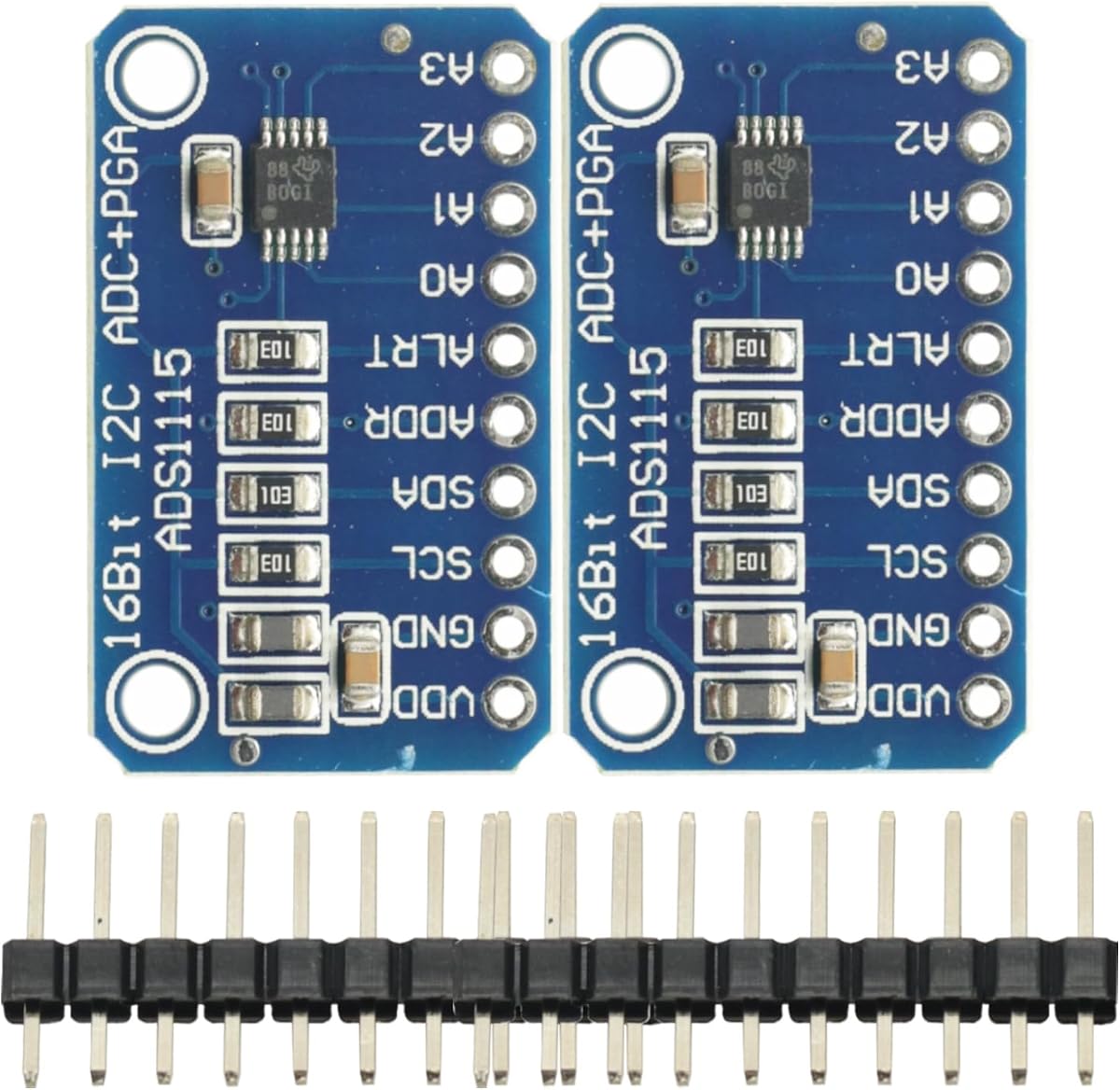
This 2Pcs ADS1115 kit offers a highly rated and affordable solution for developers needing reliable analog conversion for Arduino and Raspberry Pi projects.
We may earn a commission when you buy through this link, at no additional cost to you.
The variety of programmable input ranges ensures you can adapt the module to different sensor outputs optimizing accuracy for your specific measurement requirements.
Despite its low cost it maintains solid build quality and compatibility ensuring stable performance across a wide range of voltage and environmental conditions.
Ideal for educational labs or prototyping this pack allows you to experiment with multiple ADC units without breaking your project budget significantly.
Seven selectable input ranges enable flexible adaptation to various sensor signals improving measurement precision across different voltage levels effectively.
Getting two modules in one package reduces cost per unit and ensures you have a backup ready for redundancy in larger projects.
We may earn a commission when you buy through this link, at no additional cost to you.
The HiLetgo 3pcs ADS1115 pack provides a robust foundation for projects requiring multiple analog inputs without the complexity of managing separate ADC modules.
We may earn a commission when you buy through this link, at no additional cost to you.
Its comparator mode feature adds extra functionality for threshold monitoring tasks allowing direct digital alerts when signals exceed set voltage levels effectively.
With programmable gain and auto shut down features it balances power efficiency with measurement accuracy ensuring longevity for battery powered sensor deployments.
This bundle is perfect for distributed sensing networks where having several reliable conversion points is necessary for comprehensive environmental monitoring projects.
The comparator mode allows direct digital outputs when input signals cross thresholds reducing CPU load on your main microcontroller significantly.
Auto shut down and single-shot modes optimize power consumption extending battery life for remote or standalone sensor monitoring applications effectively.
We may earn a commission when you buy through this link, at no additional cost to you.
This 4Pcs ADS1115 set offers the largest quantity available for users needing extensive analog input capabilities across multiple points in a large scale system.
We may earn a commission when you buy through this link, at no additional cost to you.
Each module supports differential inputs which helps cancel out noise and interference ensuring accurate measurements in electrically noisy industrial environments effectively.
Standard ADS1115 features like programmable gain and auto shut down are included ensuring consistent performance across all units in the bulk pack.
It is an ideal solution for classroom labs or industrial deployments where spare units are needed for maintenance and system expansion over time.
Differential signal sampling allows the board to ignore common mode noise improving signal integrity in high interference environments significantly.
Having four modules available simplifies scaling your sensor network without needing to order additional parts later during development cycles.
We may earn a commission when you buy through this link, at no additional cost to you.
The 2PCS ADS1115 module delivers top-notch reliability with perfect ratings for users needing a versatile and accurate analog conversion solution for sensors.
We may earn a commission when you buy through this link, at no additional cost to you.
Its seven programmable input ranges enable precise measurements of various signal amplitudes ensuring high resolution across different types of analog data sources.
With a wide voltage supply and flexible I2C addressing it integrates seamlessly into diverse projects without requiring additional logic level shifting components.
This board is highly recommended for general purpose sensor interfacing and small scale data logging projects where ease of use and accuracy are paramount.
Programmable input ranges allow you to tune the ADC for specific signal levels maximizing precision for your particular sensor measurement needs.
Flexible I2C addressing and voltage compatibility simplify wiring and connection to various microcontrollers reducing setup time effectively.
We may earn a commission when you buy through this link, at no additional cost to you.
Lonely Binary offers a premium take on the classic ADS1115 module with ENIG plating and logic tolerance for reliable performance in demanding environments.
We may earn a commission when you buy through this link, at no additional cost to you.
Its gold plated connectors ensure superior solderability and oxidation resistance making it ideal for projects requiring long-term durability and stable electrical contact.
The module supports both 3.3V and 5V logic natively simplifying connections to modern ESP32 and other advanced microcontrollers without extra level shifting.
This pack is an excellent choice for advanced hobbyists and educators prioritizing component quality and long-term reliability for serious electronics projects.
ENIG plating resists oxidation and improves solderability ensuring reliable connections even in humid or high-stress environmental conditions.
Native support for both 3.3V and 5V logic levels removes the need for additional level shifters simplifying circuit design significantly.
We may earn a commission when you buy through this link, at no additional cost to you.
The Teyleten AD7606 module is designed for industrial data acquisition where synchronized multi-channel sampling and high speed are non-negotiable requirements.
We may earn a commission when you buy through this link, at no additional cost to you.
With a 200KHz sampling rate and simultaneous sampling across all eight channels it captures transient signals accurately for vibration and power analysis tasks.
Its ability to handle ±10V inputs makes it suitable for direct connection to line sensors without extensive external attenuation or conditioning circuits.
While the setup is complex this board is essential for professional applications requiring precise timing and high bandwidth signal acquisition capabilities.
Synchronized sampling across all channels ensures precise timing alignment for multi-sensor analysis critical for vibration and power studies.
Input range of ±10V allows direct measurement of larger signals reducing the need for external attenuators or signal conditioning hardware.
We may earn a commission when you buy through this link, at no additional cost to you.
This 4PCS ADS1115 kit offers reliable performance with high stability ratings for general purpose sensor interfacing and data acquisition tasks.
We may earn a commission when you buy through this link, at no additional cost to you.
Its programmable gain amplifier and standard I2C interface make it easy to integrate with Arduino and Raspberry Pi systems without complex wiring.
The four module pack provides excellent value for students or makers needing multiple ADC channels for distributed measurement points in a single project.
A solid choice for educational labs and prototyping environments where consistent performance and cost efficiency are more important than high speed.
Designed for stable and accurate readings ensures reliable sensor data over extended periods essential for monitoring applications.
Compatibility with major platforms like ESP32 and STM32 allows flexibility in microcontroller choice without hardware rework needed.
We may earn a commission when you buy through this link, at no additional cost to you.
The HiLetgo ADS1115 single unit offers a proven reliable standard for anyone needing precise analog conversion on Arduino boards without multiple packs.
We may earn a commission when you buy through this link, at no additional cost to you.
Its wide supply range and built-in comparator mode give flexibility for threshold detection and varying power source environments effectively.
Users appreciate its ease of use and compatibility with Raspberry Pi making it a go-to choice for those lacking analog GPIO pins.
This board is recommended for single project needs or beginners looking for a straightforward introduction to precision analog data acquisition.
Designed to fill the analog pin gap on Raspberry Pi boards enabling easy analog sensor integration without extra hardware.
Support for comparator mode allows simple threshold triggers reducing microcontroller workload for basic monitoring and alert tasks.
We may earn a commission when you buy through this link, at no additional cost to you.
Selecting the right ADC board depends on several technical factors including resolution channel count and communication interface.
Resolution determines how finely the board can measure voltage differences. Higher bit counts like 16-bit or 24-bit provide greater detail which is essential for sensitive sensors like thermocouples.
Always choose a resolution that matches your signal requirements to avoid unnecessary complexity or data loss.
Determine how many analog inputs you need simultaneously. Modules like the ADS1115 offer four channels while others like the ADS1256 support eight or more.
Ensure the channel count matches your project size to avoid multiplexing extra hardware or complex wiring setups.
Most modern boards use I2C which saves pins but SPI is often faster for high-speed data collection. Check your microcontroller capabilities and pin availability.
I2C is simpler for beginners while SPI is better for projects requiring rapid data sampling rates.
Check that the board supports your power supply and logic voltage levels. Some boards operate on 3.3V and others on 5V to ensure compatibility.
Using the correct voltage prevents damage and ensures stable communication between the ADC and your Arduino or ESP32.
A built-in PGA allows you to adjust the input range for better sensitivity. This is vital for measuring small signals without external amplification.
Look for boards with programmable ranges to maximize resolution across different sensor types and signal strengths.
If your project involves fast changing signals like vibration or audio you need a high sample rate. Standard I2C boards are slower than SPI based high-speed modules.
Match the sample rate to your signal frequency to avoid missing important data points during acquisition.
For battery powered devices consider the power consumption of the ADC. Look for features like auto shut down or low power modes to extend battery life.
High precision boards often consume more power so balance your needs against your power constraints effectively.
Higher quality boards with better plating and construction last longer especially in industrial or outdoor environments. Check for features like ENIG finish.
Investing in a durable module can prevent failures over time and save costs on replacement units.
Begin by connecting the power and ground pins to your microcontroller. For I2C modules connect SDA and SCL to the corresponding pins on your Arduino or ESP32.
Install the appropriate driver library in your Arduino IDE or development environment to communicate with the module. Most boards use standard libraries like Adafruit ADS1x15.
Run a test sketch to verify communication and reading accuracy. Ensure the wiring is secure and the input signals are within the specified voltage range.
I2C boards use two wires for communication which saves microcontroller pins but are generally slower. SPI boards use more wires but offer higher data transfer speeds for faster sampling.
External ADCs provide higher resolution such as 16-bit or 24-bit compared to the built-in 10-bit. They also support more channels and better precision for sensitive applications.
Yes most of these boards work well with Raspberry Pi via I2C or SPI interfaces since the Pi lacks native analog input pins for direct sensor reading.
Use decoupling capacitors near the power pins and ensure stable reference voltages. Shielding cables and keeping analog wires away from digital ones also helps reduce interference.
A PGA adjusts the input signal range to improve resolution for small signals. It allows you to amplify weak signals internally before conversion.
Not always. 24-bit offers higher precision but is often slower and more complex. 16-bit is sufficient for many common sensor applications like temperature or pressure.
Most ADS1115 modules have selectable addresses allowing up to four modules on the same bus. This provides 16 total channels for multi-sensor setups.
Most boards can be powered directly from the 5V or 3.3V pins on your microcontroller. However complex setups may benefit from a separate regulated supply.
We have reviewed ten top options from budget-friendly 16-bit modules to professional 24-bit converters suitable for various project needs.
Prioritize resolution and channel count based on your specific sensor requirements to ensure accurate data acquisition for your application goals.
Always verify current availability and check for the latest driver updates before purchasing to ensure a smooth integration into your projects.