
CENMATE Aluminum 12 Bay
4.3Editor score
USB 3.0 Fast Transfer
Tool-Free Hot Swappable
Aluminum Cooling Design
Finding the right storage solution is critical for managing large data sets efficiently. A 16 bay NAS enclosure offers massive capacity and flexibility for both personal and professional environments requiring significant archival space.
We evaluated ten leading models based on build quality, connectivity options, cooling efficiency, and overall reliability. Each product was selected for its ability to handle high-density storage demands while maintaining stable operation under load.
Every pick highlights key strengths and potential trade-offs to help you match a unit to your specific workflow. Please note that availability and pricing can change frequently, so verify current details before purchasing your preferred model.
4.3Editor score
4.3Editor score

4.5Editor score
As an Amazon Associate we earn from qualifying purchases.
This table provides a side-by-side overview of key specifications across all ten models to help you quickly identify the unit that best fits your technical requirements and budget constraints.


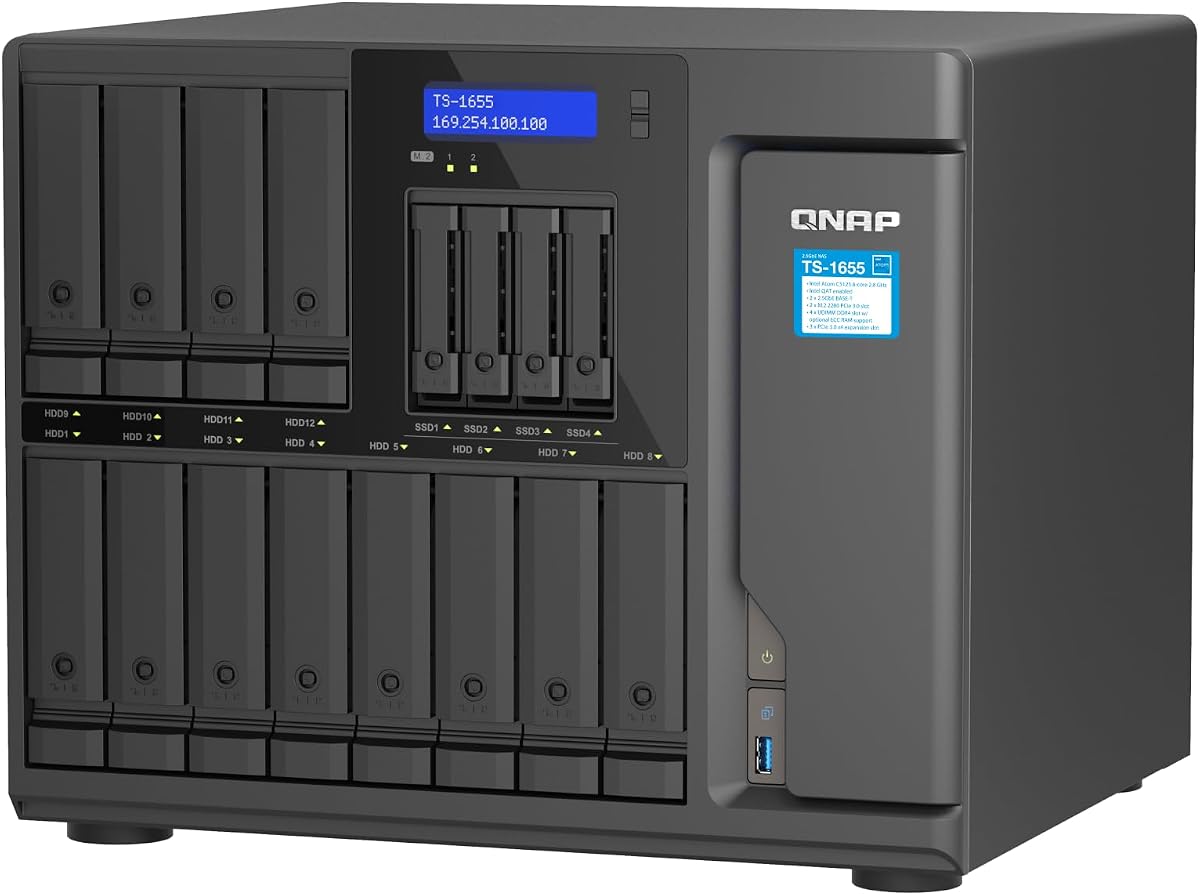
This QNAP model stands out as a robust solution for users needing high capacity and performance. It balances processing power with storage flexibility, making it ideal for workgroups or advanced home labs.
We may earn a commission when you buy through this link, at no additional cost to you.
The Intel Atom C-5125 processor provides sufficient headroom for virtualization and media services. Support for up to 128GB of ECC RAM ensures data integrity during intensive operations like database hosting.
While it offers excellent performance, the interface can be overwhelming for first-time NAS users. Additionally, the active cooling system may generate noise in quiet environments, which should be considered for home office setups.
Ultimately, this unit is recommended for those who require a balance of enterprise features and capacity without stepping into full rackmount territory. It delivers reliability and speed for demanding workflows.
The eight-core processor and ECC RAM support make this unit capable of running multiple virtual machines simultaneously without significant performance degradation.
With support for both 3.5 and 2.5-inch drives plus M.2 NVMe slots, you can optimize your storage pool for speed and capacity effectively.
We may earn a commission when you buy through this link, at no additional cost to you.
The CENMATE enclosure offers an accessible entry point for those needing direct attached storage without a full NAS operating system. It supports up to 240TB total capacity with standard SATA drives.
We may earn a commission when you buy through this link, at no additional cost to you.
Its aluminum construction helps dissipate heat while keeping the unit relatively light. Tool-free trays make swapping drives simple, and the USB 3.0 interface ensures fast transfer rates for large files.
Users should note that this is a DAS device, meaning it lacks internal RAID controllers. You rely on software RAID for data protection, which may be less convenient for some setups.
This enclosure is best suited for tech-savvy users who want maximum storage per dollar. It works well for backups or media libraries where speed and capacity matter more than enterprise redundancy.
A USB HOST port allows connecting additional enclosures to expand capacity further, potentially reaching over 700TB with multiple units.
Three internal fans ensure drives stay cool under load, though they may produce noticeable noise in quiet office environments.
We may earn a commission when you buy through this link, at no additional cost to you.
This rackmount unit represents the high end of the spectrum, designed for businesses that cannot afford downtime. It delivers exceptional sequential read speeds and handles compute-intensive services with ease.
We may earn a commission when you buy through this link, at no additional cost to you.
The inclusion of redundant power supplies ensures that the system keeps running even if one power source fails. Two PCIe slots allow for network card upgrades or cache adapters to boost performance further.
While the price is significant, the five-year warranty and robust build justify the cost for critical infrastructure. However, its form factor requires a rack or specific mounting solution.
It is the ideal choice for small to medium businesses needing reliable, high-performance storage. The Synology DSM software adds value through intuitive management and extensive app support.
Redundant power and expandable drive bays ensure your business data remains accessible even during hardware failures or maintenance windows.
PCIe slots allow you to install high-speed network cards or NVMe cache modules tailored to your specific workload requirements.
We may earn a commission when you buy through this link, at no additional cost to you.
This expansion unit is designed to work alongside specific Synology NAS models to add significant storage capacity. It simplifies the process of growing your storage without replacing your entire system.
We may earn a commission when you buy through this link, at no additional cost to you.
Synology DSM tools allow you to configure new storage pools quickly. The unit comes with a five-year warranty, matching the reliability standards of Synology base units.
It only functions when connected to a supported NAS, so buyers must ensure compatibility before purchasing. This limitation means it is not a standalone solution but a powerful add-on.
For Synology users needing more space, this is a practical and reliable choice. It integrates smoothly into existing workflows and maintains the ecosystem's ease of use.
Setting up the expansion takes just minutes through the DSM interface, making it easy to add capacity without downtime.
All drives, whether internal or in the expansion unit, are managed from a single dashboard for streamlined administration.
We may earn a commission when you buy through this link, at no additional cost to you.
This chassis is built for DIY enthusiasts who want to construct a custom server or workstation. It supports a wide range of motherboard sizes and includes hot swap bays for flexibility.
We may earn a commission when you buy through this link, at no additional cost to you.
The steel construction ensures durability, and it can accommodate GPUs for graphics-intensive tasks. Eight PCI slots offer extensive expansion options for network cards or storage controllers.
Buyers should expect shipping delays as the product is shipped by sea. Assembly is not included, so you need hardware and technical skills to complete the build.
It is perfect for those who need a tailored solution with specific component requirements. The value comes from its versatility and capacity to handle heavy workloads.
Support for EATX and GPU cards allows you to build a machine that doubles as a server and a powerful workstation.
Fifteen hot swap bays let you replace drives without shutting down the system, ideal for continuous uptime requirements.
We may earn a commission when you buy through this link, at no additional cost to you.
This Asustor model emphasizes high-speed connectivity and modern standards like USB4 and DDR5 RAM. It is designed for enthusiasts and small businesses requiring fast file access.
We may earn a commission when you buy through this link, at no additional cost to you.
The AMD Ryzen processor combined with ECC memory ensures stability during continuous operation. Dual 10GbE ports allow for aggregated bandwidth to handle multiple users efficiently.
Although it has only ten drive bays, it targets specific workflows like media production. The cost may be high for general home use compared to simpler units.
It is a strong recommendation for video editors or data-heavy users. The networking and memory features provide a significant boost over standard home NAS models.
USB4 and 10GbE support future-proof your storage against upcoming high-speed devices and network upgrades.
ECC DDR5 RAM corrects memory errors on the fly, reducing the risk of data corruption in critical applications.
We may earn a commission when you buy through this link, at no additional cost to you.
The DS3622xs+ is a high-performance desktop NAS designed for demanding environments. It offers excellent random read performance and supports massive memory for virtualization tasks.
We may earn a commission when you buy through this link, at no additional cost to you.
Its scalable design allows you to add two DX1222 units to reach 36 drive bays. The Xeon processor handles heavy workloads like databases and video management effectively.
The rating is slightly lower due to the cost compared to consumer units. However, the performance metrics justify the expense for business-critical operations.
This unit is ideal for IT managers needing reliable, expandable storage. It provides enterprise features in a desktop chassis that fits under a desk.
Support for two expansion units means you can grow from twelve to thirty-six bays as your needs evolve.
Over 260k random IOPS ensures snappy performance for applications that rely on frequent small file reads.
We may earn a commission when you buy through this link, at no additional cost to you.
This rackmount JBOD is ideal for data centers or server rooms needing dense storage expansion. The short depth design makes it easier to fit in smaller cabinets with complex cabling.
We may earn a commission when you buy through this link, at no additional cost to you.
Redundant power supplies ensure the unit stays online during power issues. Mini-SAS HD connections provide stable, high-speed data transfer to your primary NAS.
It requires a compatible QNAP NAS to function, so verify compatibility before buying. Also, note that the rail kit must be purchased separately.
For enterprises needing petabyte-level capacity, this is a reliable option. It offers robust power management and efficient use of rack space.
Short depth design minimizes cable clutter in tight server racks while maintaining full drive capacity.
Redundant power ensures continuous operation even if one supply fails, critical for unattended server environments.
We may earn a commission when you buy through this link, at no additional cost to you.
This unit is designed for desktop computers needing a massive local storage upgrade. It includes a dedicated PCIe card for connection, which is often sold separately for other enclosures.
We may earn a commission when you buy through this link, at no additional cost to you.
Support for both 3.5 and 2.5 drives allows flexibility in SSD and HDD mixes. The SATA 6Gbps speed ensures drives run at full potential.
It lacks advanced cooling features, so ambient room temperature matters. It also needs a spare PCIe slot in your computer which might limit cases.
Best for media workstations or local servers needing immediate bulk storage. It provides a straightforward way to add terabytes of capacity to a PC.
The included PCIe card removes the need to buy extra adapters, saving time and money for desktop upgrades.
Twelve bays for larger drives and four for smaller ones let you optimize for capacity or speed as needed.
We may earn a commission when you buy through this link, at no additional cost to you.
This model prioritizes longevity and consistent hardware availability. It offers similar specs to other hybrid NAS units, focusing on stability and long-term support.
We may earn a commission when you buy through this link, at no additional cost to you.
With ECC RAM support, it ensures data integrity for critical tasks. The eight-core processor provides enough power for multitasking and media transcoding.
QTS software is powerful but may take time to learn. Users should also consider fan noise if the unit will be in a living area.
It is a solid pick for small businesses needing reliable infrastructure. The emphasis on long-term availability ensures you can find replacements easily.
ECC support corrects memory errors automatically, maintaining data integrity over long periods of continuous operation.
Dual 2.5GbE ports allow for link aggregation or dedicated network paths to improve throughput.
We may earn a commission when you buy through this link, at no additional cost to you.
Selecting the right enclosure depends on your specific needs regarding performance, redundancy, and environment. This guide breaks down key factors to consider.
Check the maximum supported drive size and total capacity. Ensure the unit allows you to expand beyond your initial needs without replacing the whole chassis.
Always verify total capacity limits to avoid bottlenecks as your data grows over time.
USB 3.0 or SAS interfaces affect transfer speeds significantly. Ensure your host system supports the interface for optimal performance.
Faster interfaces mean quicker backups and file access across your network.
High-density storage generates heat, so adequate cooling is essential. However, fans can be loud, which matters for home offices or quiet rooms.
Consider fan noise levels and airflow design to balance performance with comfort.
Metal chassis like aluminum or steel offer better heat dissipation and protection than plastic. This ensures longevity in demanding environments.
Durable materials protect your drives from physical damage and overheating.
Hot swap bays allow drive replacement without shutting down the system. This is crucial for systems requiring high availability.
Look for tool-free hot swap trays to minimize downtime during maintenance.
Ensure the enclosure works with your operating system and existing NAS units. Some require specific PCIe cards or software drivers.
Always check OS and software compatibility before finalizing your purchase.
Redundant power supplies add a layer of security against power failures. Standard PSUs may be sufficient for non-critical personal use.
Redundancy ensures continuous operation even if one power source fails.
Enclosures with RAID or OS integration simplify management. DAS units rely on your computer for these tasks.
Choose integrated software for ease of use or external control for flexibility.
Start by connecting the unit to a stable power source and your computer or network. Install the provided software or drivers if required for your operating system.
Insert drives carefully into the bays to ensure good connection. Avoid touching the contacts directly to prevent static discharge or damage.
Regularly check drive health using built-in tools or external software. Keep the vents clean of dust to maintain optimal cooling and performance.
A NAS (Network Attached Storage) has its own operating system and connects directly to a network. A DAS (Direct Attached Storage) connects to a single computer via USB or PCIe. NAS allows shared access while DAS offers simpler plug-and-play use.
Most modern enclosures support mixing 3.5 and 2.5 drives in separate bays. However, RAID configurations might require matching sizes for optimal redundancy and performance.
Check the manufacturer's compatibility list. Some enclosures require specific models or firmware versions to function correctly as expansion units.
For home use, non-ECC RAM is usually sufficient. However, ECC memory reduces the risk of silent data corruption which is vital for critical business data.
PCIe cards provide dedicated high-speed data paths to the motherboard. This is common for desktop enclosures to ensure maximum transfer rates without USB bottlenecks.
Place the unit in a well-ventilated area away from living spaces. Some models allow fan curve adjustments to lower speeds during idle times.
We have highlighted the top 16 bay NAS enclosures for various needs ranging from budget-friendly DAS units to enterprise-grade rackmounts. Each model offers distinct advantages for specific workflows.
Prioritize performance and reliability if your data is critical. For simpler needs, focus on capacity and ease of installation.
Prices and availability fluctuate frequently. Check the latest details on the retailer site before making your final decision.