
EZRED SP101
4.6Editor score
Simple hydrometer design
Rugged service station grade
No temperature tables needed
This comprehensive guide compares the top 10 lead acid battery testers for 2026, analyzing accuracy, features, and value to help you choose the right diagnostic
Finding a reliable lead acid battery tester is essential for anyone who owns a vehicle or maintains backup power systems. These tools help diagnose charging issues and prevent unexpected breakdowns on the road or at home.
We evaluated ten top-rated models based on accuracy, ease of use, and compatibility with different battery types like AGM, Gel, and Flooded. Our analysis includes professional-grade options and affordable handheld units for DIY enthusiasts.
Each pick in this list highlights specific strengths such as conductance testing, QR reporting, or rugged design. Please note that prices and availability may change, so verify current details before purchasing your preferred model.
4.6Editor score
4.5Editor score

5.0Editor score
The following comparison table provides a side-by-side overview of all ten models, highlighting key specifications and capabilities to help you quickly identify the best fit for your specific testing needs.




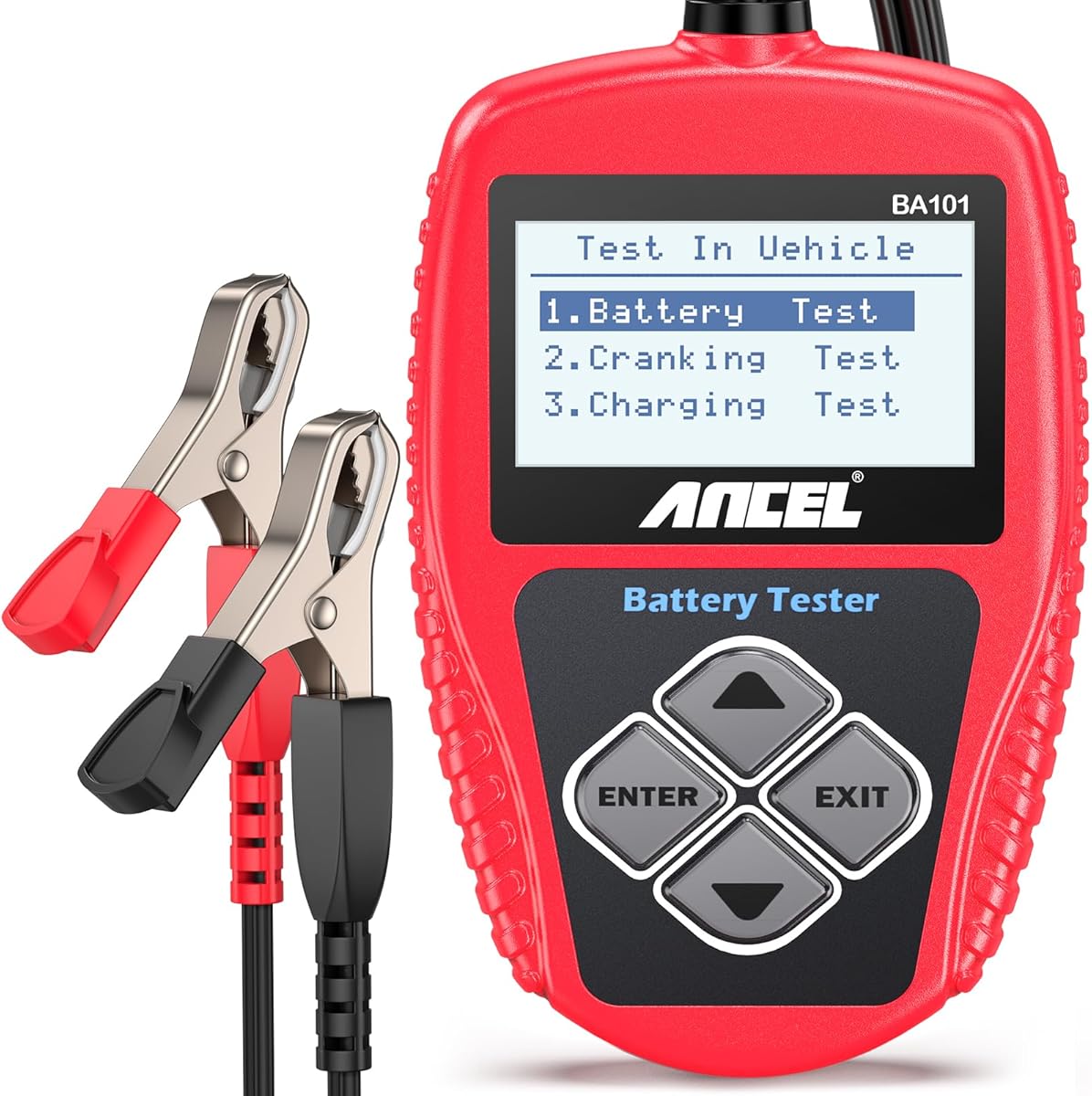
The ANCEL BA101 is a versatile digital tester designed for 12V lead-acid batteries found in most cars and small trucks. It delivers clear readings for State of Health, State of Charge, and CCA, making it easy to understand battery status without complex interpretation.
We may earn a commission when you buy through this link, at no additional cost to you.
Its built-in protection against reverse polarity and overvoltage ensures safety during testing, while the high-quality copper clips provide stable connections. The adjustable contrast and white backlight make it usable in various lighting conditions, from bright garages to dim under-hood spaces.
While it lacks 24V compatibility and lithium battery support, these limitations are acceptable for users focused on standard automotive applications. The lack of a thermal printer is also noted, but the clear screen display suffices for most diagnostic needs.
This tool is ideal for DIYers and technicians who need reliable, fast results for 12V vehicles. It balances affordability with professional-grade accuracy, making it a top choice for maintaining vehicle electrical systems effectively.
The device uses advanced conductance technology to simulate a full discharge test quickly, providing accurate SOH and SOC readings without draining the battery power.
Safety is prioritized with 4-in-1 protection circuits and reinforced ABS housing, allowing users to test confidently even in tight or risky electrical environments.
We may earn a commission when you buy through this link, at no additional cost to you.
The EZRED SP101 offers a traditional hydrometer approach for testing flooded lead-acid batteries. It allows users to directly measure the specific gravity of the battery acid, providing a clear indication of the state of charge without any electronics.
We may earn a commission when you buy through this link, at no additional cost to you.
Its rugged design is built to withstand tough treatment in service stations and garages. The clear tube design ensures both customers and technicians can see the readings easily, and it eliminates the need for complex temperature tables or calibration steps.
However, this tool is limited to flooded batteries and requires opening the caps to access the acid, which is not feasible for sealed AGM or Gel types. It is also slower compared to digital conductance testers, but the cost is minimal.
This hydrometer is perfect for maintaining flooded batteries on motorcycles, boats, or older vehicles where simplicity and low cost are priorities. It remains a reliable backup for verifying battery health without relying on digital components.
By measuring specific gravity directly, the SP101 provides an accurate chemical assessment of the battery plates without needing batteries or internal memory systems.
Designed by EZRED, this tool stands up to professional use in service stations, ensuring that readings remain consistent over time despite frequent handling and harsh conditions.
We may earn a commission when you buy through this link, at no additional cost to you.
This intelligent tester stands out by simulating a full 20-hour C20 discharge test in just seconds, displaying actual Ah remaining capacity alongside voltage. It is ideal for applications like UPS systems, mobility scooters, and sealed lead-acid batteries where capacity is critical.
We may earn a commission when you buy through this link, at no additional cost to you.
The unit is powered directly by the battery under test, removing the need for external power sources or internal batteries. It supports various battery types including SLA, AGM, Gel, and flooded, offering versatility for specialized equipment maintenance.
While the price is higher than standard automotive testers, the ability to test Ah capacity makes it invaluable for off-grid and backup power users. The reverse polarity protection ensures safety even if connections are made incorrectly.
Investors in deep cycle or standby power systems should consider this tester for its precision. It fills a niche that standard CCA testers cannot address, providing a detailed health report beyond simple charge levels.
By simulating a 20-hour discharge, the tester predicts actual battery life and capacity accurately without draining the unit, offering insights standard voltage tests miss.
Compatible with SLA, Gel, and Flooded batteries, this device handles diverse chemistries found in marine, automotive, and backup power applications with equal ease.
We may earn a commission when you buy through this link, at no additional cost to you.
The ACT 612 is a trusted tool among professionals for testing SLA, Gel, and Flooded batteries. It provides consistent and accurate readings that help determine battery health quickly and reliably.
We may earn a commission when you buy through this link, at no additional cost to you.
Its intelligent testing algorithms ensure that results are meaningful and actionable, saving time in workshop environments. The build quality reflects its professional status, designed to endure frequent daily use.
However, compared to newer models with color screens, it may feel dated in terms of user interface. Users focused purely on function will appreciate its straightforward operation without unnecessary complexity.
For shops that need a workhorse to test various lead-acid types, this device delivers. It remains a solid choice for technicians who prioritize accuracy over modern digital features.
Used in professional settings, this tester offers the consistency required to make accurate replacement recommendations for customers and fleet managers alike.
We may earn a commission when you buy through this link, at no additional cost to you.
The ANCEL BT410 extends compatibility to 12V and 24V systems, making it suitable for heavy-duty trucks and vans. It also supports lithium-ion batteries, a feature rarely found in mid-range testers.
We may earn a commission when you buy through this link, at no additional cost to you.
With a 2.4-inch color TFT screen and QR code reporting, users can easily share test data with clients or record history digitally. The smart chip ensures over 99.9 percent accuracy, minimizing false diagnostics.
Although it requires entering battery data, the process is streamlined. The long cables ensure reach to hard-to-access battery locations, which is crucial in modern vehicle layouts.
This tester is recommended for fleet owners or enthusiasts with diverse vehicle types. The combination of voltage range and lithium support provides a future-proof solution for evolving battery technologies.
As electric and hybrid adoption grows, supporting lithium batteries alongside lead-acid ensures this tool remains relevant for modern vehicle electrical systems.
We may earn a commission when you buy through this link, at no additional cost to you.
The BT60 PRO offers a wide capacity range and supports cloud printing via QR codes, allowing professional service providers to document tests efficiently. It handles 6V to 24V batteries seamlessly.
We may earn a commission when you buy through this link, at no additional cost to you.
The 3.2-inch HD screen provides excellent readability, and the ergonomic design ensures comfort during repeated tests. Built-in LED lights help illuminate battery terminals in dark engine bays.
While lithium CCA measurements are not guaranteed, voltage and health checks are available. This limitation is acceptable given the device's primary focus on lead-acid systems.
For workshops needing organized record-keeping, the cloud printing feature is a significant advantage. It simplifies compliance and customer communication without extra hardware.
The cloud printing feature allows instant sharing of test results, helping technicians maintain accurate service records and communicate findings clearly to customers.
We may earn a commission when you buy through this link, at no additional cost to you.
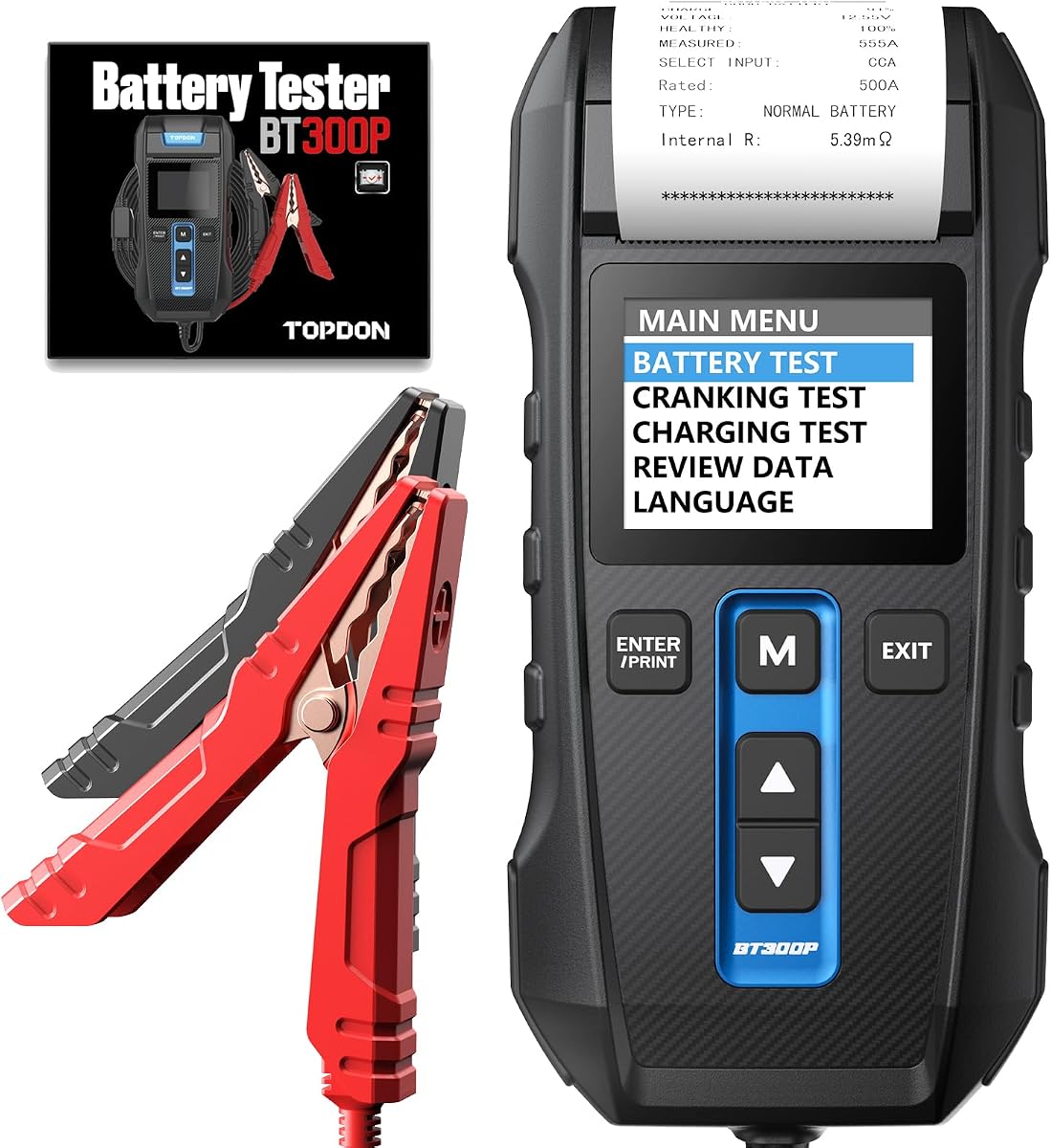
The TOPDON BT300P features a built-in thermal printer that produces physical receipts of test results. This is ideal for customer-facing work where a paper record is required for transparency.
We may earn a commission when you buy through this link, at no additional cost to you.
Using thermal paper eliminates the need for ink cartridges, making it maintenance-friendly. The test completes in just three seconds, keeping workflow efficient in busy service centers.
Safety is ensured with spark-free clamps and automatic protection against reverse polarity. The long cables provide ease of access to distant battery terminals.
For mechanics and garages that need to provide proof of service, this printer feature is invaluable. It combines speed with tangible documentation to enhance customer trust.
The ability to print results immediately helps build trust with clients who want visible proof of battery health without digital sharing complications.
We may earn a commission when you buy through this link, at no additional cost to you.
The MOTOPOWER MP0515A provides solid performance at a competitive price. It covers standard 12V batteries and includes alternator analysis, making it a complete electrical system tool.
We may earn a commission when you buy through this link, at no additional cost to you.
Its compact design makes it easy to store in a glove box or toolkit. The color LCD screen is user-friendly, and the device supports nine languages for international use.
While it lacks some advanced reporting features, it delivers essential data for general diagnostics. The data storage function allows for basic review of test history.
This model suits DIYers who need reliable diagnostics without paying premium prices. It balances features and cost effectively for everyday vehicle maintenance tasks.
Beyond battery health, it checks alternator output, ensuring users can identify if charging issues stem from the battery or the generator.
We may earn a commission when you buy through this link, at no additional cost to you.
The FOXWELL BT705 includes a 5.9-foot cable, allowing one-person testing by reaching the driver's seat while connecting to the battery. This is particularly useful for larger vehicles with deep engine bays.
We may earn a commission when you buy through this link, at no additional cost to you.
It provides guided prompts on a 2.8-inch screen, making it easy for beginners to interpret results. The results are summarized as Good, Recharge, or Replace, simplifying decision-making.
The device comes with a protective hard case, ensuring safety during transport. It supports 12V and 24V systems with high accuracy for various battery chemistries.
For solo mechanics or fleet managers, the long cable is a major convenience. It reduces the need for helpers and ensures safe, comfortable testing procedures.
The extended cable length allows users to monitor tests from the driver's seat, making it easier to start the engine and observe readings simultaneously.
We may earn a commission when you buy through this link, at no additional cost to you.
The ANCEL BA101PRO is built for 12V and 24V heavy-duty vehicles, offering robust testing capabilities for commercial and industrial applications. It supports a wide range of battery types including AGM and EFB.
We may earn a commission when you buy through this link, at no additional cost to you.
A function key allows one-touch testing, streamlining operations in busy repair shops. The 2.8-inch color display clearly shows voltage curves and allows replay of up to 120 seconds of data.
It stores up to 1,400 records, enabling detailed tracking of battery health over time. Protection features prevent damage from incorrect connections or power surges.
For owners of trucks, RVs, or boats, this model provides the durability and features needed for reliable maintenance. It is a practical upgrade for users requiring heavy-duty compatibility.
With one-touch testing and extensive data storage, technicians can quickly manage and track battery health across multiple vehicles in a fleet.
We may earn a commission when you buy through this link, at no additional cost to you.
Choosing the right battery tester depends on your specific vehicle types and testing needs. This guide covers essential factors to consider for making an informed purchase.
Ensure the tester supports the voltage of your batteries, such as 12V, 24V, or both. Some units are limited to 12V while others cover heavy-duty systems.
Check if the device is compatible with your battery chemistry like AGM, Gel, or Flooded to ensure accurate readings across different types.
Look for conductance or load testing methods which provide more accurate State of Health data compared to simple voltage checks.
Higher accuracy models use advanced algorithms to simulate real-world conditions, ensuring reliable diagnostics for safety-critical applications.
A clear display with backlighting is essential for reading results in dark engine bays or outdoor environments.
Color screens often provide better visualization of data trends and are easier to read quickly during busy testing sessions.
Consider models that offer data storage or QR reporting to keep track of battery history and service records.
Features like thermal printing or cloud sharing help professionals provide proof of service and maintain organized maintenance logs.
Safety features such as reverse polarity protection and spark-free clamps prevent accidental damage to the vehicle or tester.
Robust housing and insulated cables ensure durability and safe operation even in harsh workshop or field conditions.
User-friendly interfaces with guided prompts or one-touch testing reduce setup time and minimize human error.
Longer cables and ergonomic designs improve comfort and convenience, especially when accessing hard-to-reach battery terminals.
Determine your budget range based on the frequency of use and the type of vehicles you maintain regularly.
Investing in a higher-end model may save money long-term by preventing unnecessary replacements and providing better diagnostics.
Before testing, ensure the battery terminals are clean and free of corrosion to maintain stable connections with the tester clamps.
Enter the correct battery type and capacity values as specified on the label to ensure accurate CCA and State of Health readings.
After use, disconnect the clamps properly, store the device in a dry place, and inspect cables for wear to extend its lifespan.
A hydrometer measures the specific gravity of the battery acid, providing a direct chemical reading. A digital tester uses electrical conductance to estimate battery health without accessing the acid.
No, standard testers may not be calibrated for AGM batteries. Ensure your device explicitly supports AGM or Gel chemistries to avoid inaccurate readings.
It is recommended to test your vehicle battery at least once a year, especially before winter, to ensure reliability and prevent unexpected failures.
Most modern testers draw minimal power or use conductance methods that do not significantly drain the battery during testing.
A low CCA rating suggests the battery may struggle to start the engine in cold weather, indicating it may need replacement soon.
This warning appears when the positive and negative clamps are connected to the wrong terminals, which can damage the tester or battery.
Many standard lead acid testers do not support lithium batteries. Check the product specifications for lithium compatibility before purchasing.
This guide highlighted ten top models ranging from budget hydrometers to advanced conductance testers. The ANCEL BA101 and EZRED SP101 offer excellent value for different user needs.
Prioritize features like voltage compatibility, safety protections, and display clarity based on your specific vehicle and maintenance requirements.
Always verify the current prices and availability before purchasing to ensure you get the best deal for your chosen model today.