This guide compares the top Arduino temperature sensors for accuracy, durability, and ease of use to help you choose the right module for your project.
As an Amazon Associate we earn from qualifying purchases. We may earn a commission when you buy through links on this page, at no additional cost to you. Read our affiliate disclosure.As an Amazon Associate we earn from qualifying purchases.Purchases through our links may earn us a commission, at no extra cost to you. Read our affiliate disclosure.
Selecting the right Arduino temperature sensor is crucial for any project involving environmental monitoring or thermal control. Whether you need humidity tracking or waterproof probes, the market offers diverse options tailored to different needs and budgets for your builds.
We analyzed ten highly rated sensors based on accuracy, communication protocol, voltage range, and user feedback. This list covers everything from basic digital modules to industrial-grade waterproof probes suitable for various embedded system applications and learning setups.
Each pick highlights key strengths and ideal use cases to simplify your decision process. Note that availability and pricing may change over time, so verify current stock and offers before finalizing your purchase for your electronics projects.
Top 3 Picks for Best Arduino Temperature Sensor
Best Budget
HiLetgo 5pcs DHT11 Temperature Humidity Sensor Module Digital Temperature Humidity Sensor 3.3V-5V Humidity Measure Range 20%-95% Temperature Measure Range 0-50℃ Celsius with Wires
2pcs AHT30 High Precision Digital Temperature and Humidity Sensor Measurement Module I2C IIC Communication AHT20 AHT21 AHT10 Upgraded Version for Arduino Humidity Temperature Sensor
DROK 2 Pack Waterproof DS18B20 Temperature Sensor Probes with 2 Pack Probe Adapter Boards, Female to Female Jumper Wires and 4.7K ohm Resistors for Arduino Raspberry Pi DIY
Top 10 Best Arduino Temperature Sensor in 2026 Compared
This side-by-side comparison evaluates each sensor's key specifications and unique features to help you identify the best match for your specific Arduino project requirements and environmental conditions.
This DHT11 module from HiLetgo is a staple in the maker community for its affordability and simplicity. It comes in a pack of five modules, making it an excellent choice for classrooms or multiple prototypes. The sensor is pre-calibrated and outputs a digital signal that is easy to read with an Arduino board.
Pros
Very affordable bulk pack
Simple wiring setup
Low programming overhead
Includes pull-up resistor
Good for beginners
Cons
Limited accuracy range
Slow sampling speed
We may earn a commission when you buy through this link, at no additional cost to you.
The DHT11 sensor measures temperature and humidity using a dedicated digital module and 8-bit microcontroller. Its single-wire communication scheme reduces programming effort significantly. The included bypass capacitor and pull-up resistor on the board ensure stable operation without extra components. The wide voltage range from 3.3V to 5V ensures compatibility with most microcontrollers.
While the accuracy is not industrial-grade with ±2°C for temperature and ±5%RH for humidity, it is sufficient for hobbyist projects like weather stations or plant monitors. The response time is relatively slow compared to newer sensors, and it is best used for non-critical measurements. The resolution is limited to 1°C and 1%RH.
Anyone looking for a cost-effective solution to get started with environmental monitoring should consider this pack. The inclusion of five sensors means you can spare units or use them across multiple projects without running out. It is perfect for DIY learners needing reliable yet inexpensive hardware.
Easy Integration for Learning
The simple protocol and included components make this an ideal first sensor for new users learning Arduino basics.
Bulk Value
Buying five units at once ensures you have backups for future builds or classroom setups.
The AHT30 sensor module represents a significant upgrade over older models in terms of precision and speed. This two-pack offers exceptional value for those needing accurate environmental data. With an accuracy of ±0.3°C for temperature, it outperforms many budget options in reliability. It is ideal for projects requiring precise control.
Pros
Excellent temperature accuracy
Fast transmission speed
Stable performance
Compatible with multiple modules
Easy 4P connection
Cons
Requires I2C pins
Limited availability
We may earn a commission when you buy through this link, at no additional cost to you.
This module utilizes I2C communication, allowing multiple sensors to be connected simultaneously without pin conflicts. The voltage range from 2.0V to 5.5V makes it highly adaptable to various power systems. The 4P test line connection simplifies wiring and ensures quick setup. The stable and fast transmission speed ensures real-time readings.
The sensor operates with low power consumption, which is beneficial for battery-powered devices. Its wide temperature range from -40°C to 85°C covers most indoor and outdoor needs. The resolution of 0.01°C allows for granular data collection. However, using I2C requires available SDA and SCL pins on the board.
Enthusiasts and professionals needing high fidelity data should prioritize this sensor. It balances cost and performance better than most alternatives. Whether for home automation or industrial monitoring, the AHT30 delivers consistent results that users can trust.
Precision You Can Trust
The 0.3°C accuracy ensures your thermostat or monitoring system reacts correctly to temperature changes.
Efficient Connectivity
I2C support allows expanding your sensor network without complex wiring or pin shortages.
The SHT31-D from Teyleten Robot is a robust choice for applications demanding wide temperature coverage. It offers a measurement range from -40°C to 125°C, making it suitable for both freezer and oven monitoring tasks. The module supports I2C output for straightforward integration into existing bus networks.
Pros
Extended temperature range
I2C interface
High accuracy
3pcs pack
Reliable stability
Cons
Requires specific driver
Higher cost than basic
We may earn a commission when you buy through this link, at no additional cost to you.
This sensor provides high accuracy with ±0.3°C for temperature and ±2%RH for humidity. The operating voltage range is broad, spanning from 2.4V to 5.5V, which ensures compatibility with different logic levels. The humidity measurement accuracy of 0-100% RH allows for full-scale tracking in any environment.
Packaged as a 3pcs set, this option provides ample units for multi-site monitoring or replacements. The I2C interface simplifies wiring compared to single-wire protocols requiring pull-up resistors externally. However, users must ensure their board supports I2C libraries for the SHT31 chip specifically.
Professionals or serious hobbyists managing HVAC systems or industrial equipment will find this sensor valuable. Its stability and precision justify the investment over cheaper alternatives. The wide range ensures it can be used in challenging environments without failure.
Industrial Grade Range
Handling temperatures from -40°C to 125°C makes this versatile for both cold storage and hot industrial processes.
Efficient Data Transfer
Using the I2C bus streamlines communication and reduces pin usage on your microcontroller board.
The DS18B20 sensor by Gikfun is designed for durability in wet environments. Its stainless steel probe resists corrosion and damage, making it ideal for outdoor use. The 1-meter cable allows placement away from the main board for safety and flexibility. An adapter module simplifies connection to microcontrollers.
Pros
Waterproof stainless steel
Long 1 meter cable
Plug and play
Adapter board included
One wire protocol
Cons
Not for submersion
Longer response time
We may earn a commission when you buy through this link, at no additional cost to you.
This sensor operates on a one-wire interface, allowing multiple units to share a single data line. The measuring range spans from -55°C to 125°C, covering most common applications. It is widely used in thermostatic controls and machinery monitoring due to its reliability. The module includes a built-in pull-up resistor for easy wiring.
While it is waterproof, it is primarily designed for exposure rather than continuous submersion. The probe leads can withstand up to 85°C, so care is needed in very hot setups. The digital output provides consistent readings without noise interference. Three sets are included in the package for multiple points.
Anyone needing a robust sensor for fish tanks or greenhouses should choose this model. The long cable ensures the electronics stay dry while the probe monitors the environment. Its simplicity and durability make it a favorite for outdoor projects.
Cable Length Advantage
The 1M cable keeps your controller away from water or heat sources effectively.
Plug and Play Design
With the adapter module, you save time on wiring and can start coding immediately.
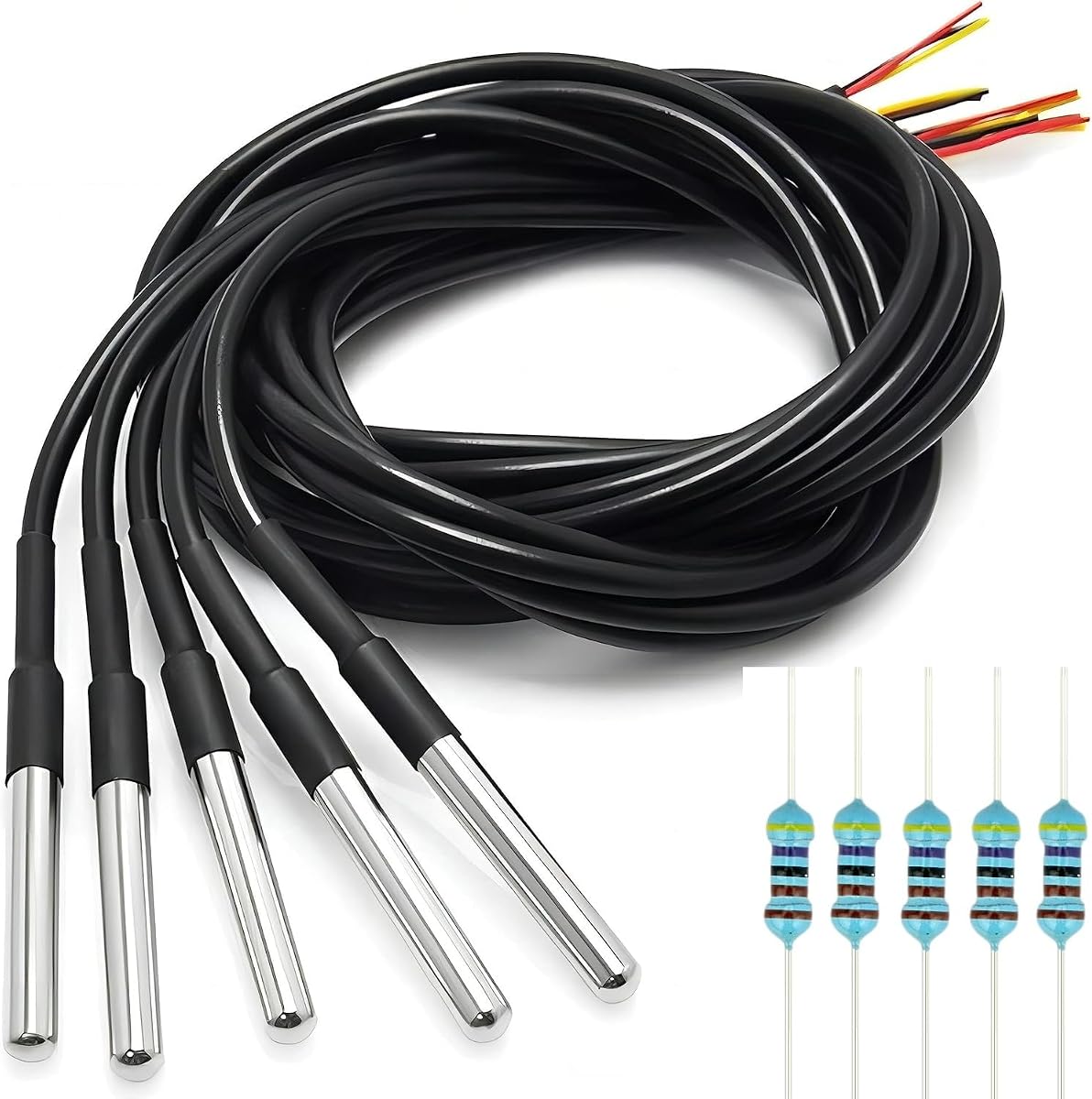
This kit offers five waterproof DS18B20 probes plus necessary resistors for a complete setup. It is perfect for projects requiring multiple sensors without sourcing extra components. The waterproof design allows for use in wet or moist environments. The high-accuracy probe delivers reliable temperature data for various applications.
Pros
Five sensors included
Resistors provided
Waterproof and durable
Great for bulk projects
Compatible with many boards
Cons
Requires external resistors
Limited precision
We may earn a commission when you buy through this link, at no additional cost to you.
The DS18B20 operates on a single bus interface, making it easy to daisy-chain multiple units. The voltage range of 3V to 5.25V ensures it works with most microcontrollers. The wide temperature range from -55°C to +125°C ensures it can be used in most scenarios. The resistors help stabilize the signal on the data line.
While the accuracy is ±0.5°C, it is sufficient for most DIY needs. The stainless steel casing protects against physical damage and moisture. This kit is an economical choice for expanding a sensor network. However, care should be taken when handling the wires during installation.
DIY enthusiasts needing multiple points for a greenhouse or water garden will appreciate this value pack. The inclusion of resistors removes the need for additional purchases. It simplifies the build process significantly for larger systems.
Complete Kit Solution
Having five probes and resistors together streamlines your purchasing process and reduces shipping costs.
Stable One-Wire Bus
The single bus interface allows scaling your project with minimal pin usage on your board.
This bundle includes two DHT11 modules designed for simple environmental monitoring tasks. The digital signal output ensures reliable communication with microcontrollers. It uses a resistive element and NTC sensor for stable performance over time. The module is perfect for basic home automation projects.
Pros
Simple wiring
Digital signal output
Stable long-term
Budget friendly
Easy to find
Cons
Basic accuracy
Slow update rate
We may earn a commission when you buy through this link, at no additional cost to you.
The sensor works on a single-wire wiring scheme, simplifying connections. It offers a humidity range of 20% to 95% and temperature from 0°C to 50°C. The low cost makes it ideal for prototyping or educational purposes. The 3.3V to 5V supply voltage ensures compatibility with various boards.
Accuracy is moderate with ±5%RH for humidity and ±2°C for temperature. This is adequate for non-critical applications like room temperature tracking. The sensor is not suitable for extreme conditions or high-precision tasks. However, its ease of use compensates for these limitations.
Students or hobbyists starting out will find this package practical. Two units provide a backup or allow simultaneous testing. It is a straightforward way to add environmental sensing to your Arduino projects without complexity.
Beginner Friendly
The simple setup and widespread library support make this an easy starting point.
Cost Effective
You can afford to buy multiple sensors for different locations without breaking your budget.
The DROK kit provides a comprehensive solution for waterproof temperature monitoring. It includes stainless steel probes that resist rust and corrosion in harsh conditions. The complete package features jumper wires and resistors, saving time on component sourcing. This is ideal for demanding applications where reliability is key.
Pros
Corrosion resistant
Jumper wires included
Integrated pull-up resistor
High accuracy
Easy integration
Cons
Requires assembly
Slightly higher price
We may earn a commission when you buy through this link, at no additional cost to you.
The DS18B20 sensors offer a wide temperature range from -55°C to +125°C with ±0.5°C accuracy. The low power design ensures efficient operation in battery systems. The adapter board has an integrated pull-up resistor for direct connection. The clear wire colors simplify wiring and reduce errors.
This sensor utilizes the robust 1-Wire protocol for simplified communication. The stainless steel housing ensures durability in continuous submersion. While it requires assembly, the included tools make it manageable. The precision makes it superior to standard probes for critical monitoring.
Users needing a ready-to-use solution for industrial or high-end projects should choose this. The kit reduces the risk of missing parts and ensures a smooth build. It is worth the investment for long-term stability.
Full Kit Convenience
Having every needed component included saves trips to the store and ensures compatibility.
High End Accuracy
The 0.5°C accuracy meets most professional standards for environmental tracking.
This five-pack offers excellent value for projects needing multiple sensor points. Each unit has a 100 cm cable, allowing wide coverage. The digital output ensures clean signals for processing. The unique single bus interface keeps wiring simple even with many devices.
Pros
Five units included
Long cable length
Stainless steel casing
Waterproof
Easy integration
Cons
Not for high heat
Requires pull-up
We may earn a commission when you buy through this link, at no additional cost to you.
The power supply range of 3.0V to 5.5V covers standard microcontroller voltages. It is widely used for thermostatic and industrial controls. The waterproof design protects against moisture damage. However, note the tips regarding using a 4.7K resistor for stable testing.
The sensors are designed for thermal monitoring where precision is needed. While they are waterproof, they should not be exposed to extreme heat beyond limits. The packaging allows for redundancy in critical systems. This is a great option for large-scale setups.
Anyone building a complex monitoring network will appreciate the quantity and length of cables. It ensures you can reach distant points without signal degradation. The cost efficiency is unmatched for such a robust kit.
Long Reach Capability
The 1M cable allows you to place sensors in hard-to-reach areas safely.
Redundant Design
With five units, you can monitor multiple areas or have spares ready.
The DHT22 module is an improved version with better accuracy. It uses the AM2302 chip for reliable sensing. The temperature range extends to 80°C, useful for warmer environments. The fixing screw holes allow for secure installation. This is a smart upgrade from basic models.
Pros
Better accuracy than DHT11
Wider temperature range
Stable readings
Mounting holes
Bidirectional data
Cons
More complex wiring
Slightly higher cost
We may earn a commission when you buy through this link, at no additional cost to you.
The sensor offers ±0.5°C accuracy for temperature and ±2%RH for humidity. This precision is useful for precise climate control. It supports bidirectional serial data for robust communication. The single-bus digital signal output simplifies coding. It is a strong candidate for home automation.
While it costs slightly more, the increased accuracy justifies the price. The broader humidity range makes it versatile for humid climates. Users should account for the different pinout compared to simpler modules. The mounting options reduce vibration issues.
Anyone needing better accuracy than the standard DHT11 should consider this. It fits well in smart home projects where precision matters. The 2pcs pack ensures you have spares or can test different locations.
Enhanced Precision
The 0.5°C accuracy ensures your climate control reacts appropriately to small changes.
Secure Mounting
Screw holes help stabilize the sensor for consistent readings over time.
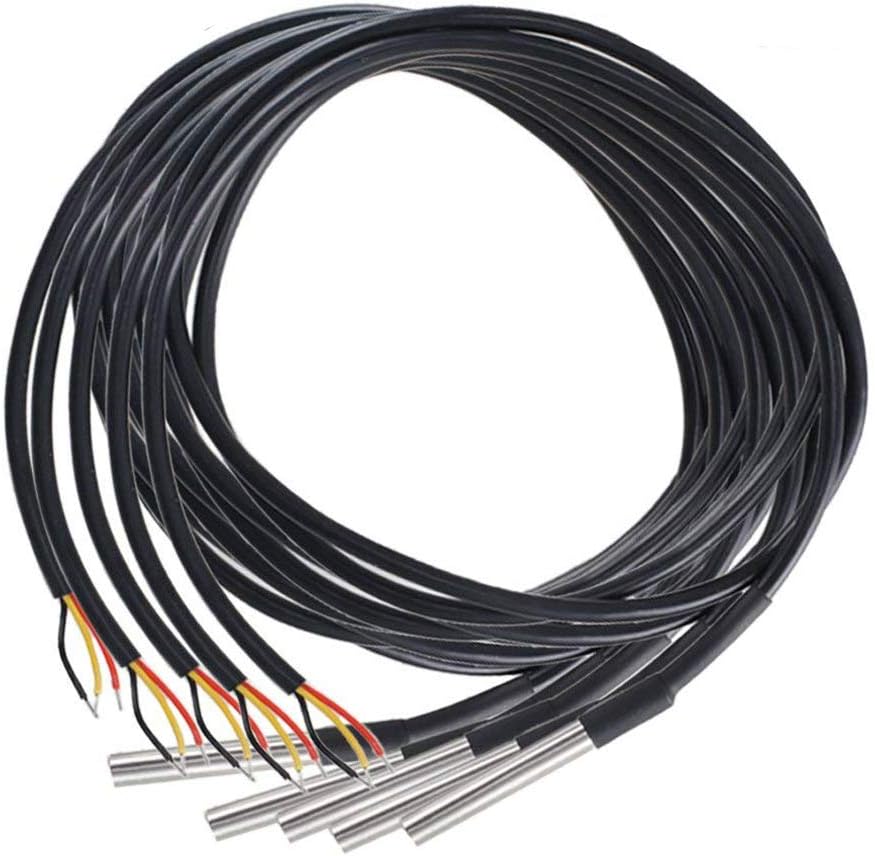
This bulk pack offers five stainless steel DS18B20 sensors for various applications. The 1-meter cables allow flexible placement in large areas. The waterproof design ensures durability in moist environments. This is ideal for users needing multiple backups or a multi-point network.
Pros
Stainless steel durable
Waterproof protection
Simple wiring
Great for backups
Cost effective
Cons
No adapters included
Basic design
We may earn a commission when you buy through this link, at no additional cost to you.
The probe package is waterproof and rustproof for long life. The wide temperature range from -55°C to +125°C supports many uses. Wiring is simple with red, yellow, and black leads. The single bus interface reduces pin usage significantly.
Users are advised to use a 4.7K resistor for testing ease. The stainless steel casing protects against physical damage. While it lacks an adapter, the direct connection is straightforward for experienced users. The quantity ensures you have replacements ready.
Anyone planning a large sensor network should consider this package. It provides consistent sensors with the same batch quality. The low cost per unit makes it a smart investment for extensive projects.
Durable Protection
The stainless steel shell resists rust and impacts in tough environments.
Scalable Network
The single bus allows connecting all five units easily without complex wiring.
We may earn a commission when you buy through this link, at no additional cost to you.
Buying Guide – How to Choose the Best Arduino Temperature Sensor
Selecting the right temperature sensor requires understanding your specific project needs regarding accuracy, range, and communication protocol. This guide breaks down the essential factors to consider.
Accuracy Requirements
The level of accuracy you need depends on your application. For basic room monitoring, sensors with ±2°C are sufficient. For industrial or precise climate control, look for ±0.3°C or ±0.5°C options. Higher accuracy often comes at a higher cost or with more complex libraries.
Prioritize accuracy based on how critical the reading is to your system's operation.
Communication Protocol
Sensors communicate via digital protocols like I2C, One-Wire, or Single-Wire. I2C allows multiple devices on two pins but requires specific libraries. One-Wire sensors like DS18B20 are flexible for many devices but require pull-up resistors. Choose the one that fits your board's pin availability.
Select a protocol that minimizes pin usage while maximizing reliability for your setup.
Temperature Range
Ensure the sensor covers your expected operating temperatures. Most hobbyists need -20°C to 80°C, but industrial users may require -55°C to 125°C. Check the datasheet to ensure the sensor does not fail or drift in extreme conditions. Some probes have limits on the wires even if the chip is robust.
Always verify the sensor's range matches your environment's extremes to prevent failure.
Waterproofing
If your project involves moisture or outdoor use, waterproof probes are essential. Stainless steel probes offer better corrosion resistance. Ensure the probe is rated for submersion if needed. The adapter module should also be protected or placed in a dry enclosure.
Choose waterproof models with metal casings for maximum durability in wet environments.
Response Time
Different sensors respond at different speeds. The DHT11 takes time to stabilize while analog or newer digital sensors are faster. If you need real-time adjustments, response time matters. Fast sensors can use more power but provide quicker updates for your control loop.
Consider how quickly your system needs to react to temperature changes when choosing.
Power Consumption
Battery-powered projects require low power consumption. Some sensors sleep between readings to save energy. Check the voltage requirements and current draw. I2C sensors often use less power than others during idle times.
Low power models ensure your battery lasts longer for remote monitoring applications.
Kit Completeness
Some packages include resistors, adapters, or wires which simplifies building. Others require sourcing these separately. A complete kit saves time and ensures compatibility. Check the product description for included components before buying to avoid extra costs.
Opt for kits that provide everything you need to get started immediately.
Software Support
Most popular sensors have well-maintained libraries for Arduino. Check if the sensor has active community support. Complex chips may need specialized drivers that can be tricky. Simple digital sensors usually have plug-and-play libraries for easy integration.
Look for sensors with strong community support to simplify your coding process.
How to Use and Care for Your Arduino Temperature Sensor
When installing your sensor, ensure proper polarity for power and ground connections. Double-check your wiring against the datasheet to avoid shorts. For One-Wire sensors, connect the pull-up resistor between the data line and VCC to ensure stable communication. Use jumper wires to connect to the Arduino pins securely.
Place the sensor away from heat sources or direct sunlight to get accurate readings. If using waterproof probes, seal the wires where they enter the casing if you plan submersion. For long-term stability, allow the sensor to warm up for a few minutes after powering on.
Keep the sensor clean from dust and moisture. If the readings drift, check the connections and power supply. Store unused sensors in a dry place to prevent corrosion. Regularly check your code for calibration adjustments as sensors may age slightly over time.
Frequently Asked Questions
Which Arduino temperature sensor is the most accurate?
The AHT30 and SHT31-D offer some of the highest accuracy in this selection. They provide ±0.3°C precision suitable for professional use. DS18B20 models also offer good accuracy at ±0.5°C for general projects. Choose these when you need reliable data for critical monitoring.
Can I use these sensors outdoors?
Yes, waterproof models like the DS18B20 probes are designed for outdoor use. Ensure the cables and connections are protected from direct exposure. The stainless steel casing resists corrosion. Use waterproof enclosures for the electronics to ensure longevity.
How many DS18B20 sensors can I connect?
You can connect many DS18B20 sensors on a single One-Wire bus. The main limit is the pull-up resistor strength and bus capacitance. Typically you can connect up to 10 units reliably on one line. Each unit has a unique ID to distinguish them.
Do I need resistors for DHT sensors?
Many DHT modules include the pull-up resistor on the board. However, you may need an external resistor for standalone chips. Check the specific product description. A 4.7K to 10K resistor is usually used for stability.
What is the difference between DHT11 and DHT22?
DHT22 offers better accuracy and a wider temperature range than DHT11. DHT22 measures up to 80°C while DHT11 stops at 50°C. DHT22 is more accurate at ±0.5°C. DHT11 is cheaper but slower and less precise.
How long do these sensors last?
These sensors typically last years with proper care. Environmental conditions like extreme heat can reduce lifespan. Ensure the operating range is respected to maintain reliability. Proper wiring and stable power also extend their life significantly.
Final Thoughts on Choosing the Best Arduino Temperature Sensor
Choosing the right sensor depends on your balance of budget, accuracy, and ease of use. The DHT11 remains a top budget option for beginners while the AHT30 offers high precision for advanced needs. The DS18B20 provides versatility for wet environments and industrial tasks.
Prioritize accuracy and waterproofing if your project involves monitoring sensitive conditions or water. For simple projects, cost-effective kits save money. Always check the power requirements and communication protocol compatibility with your board.
Remember that availability and pricing can change. Verify current specs and stock before purchasing to ensure you get the latest version. This guide aims to simplify your choice so you can build confidently and efficiently.